Growing up in the United States as the child of immigrants often means learning how to live between worlds. For Dr. Lissette Sanchez, that in-between space shaped not only her identity, but her life’s work.
In this episode of The American Dream in the Eyes of Immigrants, Dr. Sanchez—a licensed psychologist, speaker, and writer—shares a deeply personal story of growing up in Los Angeles with a Mexican father and a Salvadoran mother, navigating cultural belonging, and ultimately becoming the representation she once searched for in academic and mental health spaces
A Childhood Defined by Blended Culture
For Dr. Sanchez, childhood in Los Angeles felt normal—surrounded by Spanish speakers, immigrant families, and Latino culture woven into everyday life. What outsiders might see as a “unique” household, with parents from two different countries, felt blended and familiar.
Food became one of the earliest markers of that blending. Salvadoran pupusas shared space with Mexican rice, ceviche-style mariscos, and family traditions shaped by adaptation rather than purity. Her mother learned to cook Mexican dishes for her father, and over time, cultural distinctions softened into a shared rhythm of survival and love.
It wasn’t until years later—standing on a beach in El Salvador and ordering a shrimp cocktail—that Dr. Sanchez realized how deeply assimilation had shaped her understanding of culture. The dish didn’t look the way she expected. In that moment, she saw how migration changes memory, identity, and even taste itself
When the Bubble Bursts: Culture Shock in College
Leaving Los Angeles for college marked the first time Dr. Sanchez felt “othered.”
In classrooms where no professors looked like her, and counseling offices where she had to explain her culture before receiving support, she experienced subtle but persistent microaggressions—comments about her English, assumptions about her immigration status, and social exclusion she couldn’t yet name.
As a first-generation college student, she also became aware of class differences she had never needed to articulate before. While her parents had always provided what was necessary, she suddenly saw how limited access and unspoken rules shaped academic spaces.
“I felt small,” she shared. “I became quieter—not because I lacked ideas, but because I didn’t want to take up the wrong kind of space.”
Becoming the First — Again and Again
Despite the isolation, Dr. Lissette Sanchez kept going.
Driven by a dream she had named as early as seventh grade, she pursued higher education relentlessly—earning her master’s degree and PhD, often without a roadmap or family precedent. Her parents couldn’t guide her through applications or academic systems, but they had already given her something equally powerful: adaptability, perseverance, and resilience.
Those skills—born from immigrant survival—became the foundation that carried her through financial barriers, rejections, and moments of doubt.
Over time, her dream evolved. It wasn’t just about becoming a psychologist anymore. It was about changing the rooms she entered—so future first-generation students wouldn’t feel as invisible as she once did.
Returning to El Salvador: A Different Kind of Homecoming
Decades after her mother fled El Salvador during the civil war, Dr. Sanchez returned—not as a child, but as an adult ready to reconnect.
The trip brought unexpected emotions. She felt pride when she recognized her features in her relatives. Grief when she thought of her grandmother, who never lived to see her graduate. And vulnerability when she realized she didn’t know the “right” way to eat pupusas—using her hands instead of utensils.
That moment revealed something important: her mother had taught her to assimilate as a form of protection. What once felt like distance became an act of love.
Standing in a country she had never lived in, Dr. Sanchez felt something surprising—belonging. A sense that identity is not erased by distance, but carried quietly across generations.
Healing First-Generation Mental Health
Today, Dr. Sanchez works primarily with first-generation professionals and college students—people navigating dual identities, imposter syndrome, intergenerational trauma, and unspoken expectations.
Her mission is simple but powerful: increase representation and normalize conversations about mental health in communities where emotions were often silenced for survival.
Through therapy, speaking, writing, and advocacy, she reminds first-generation individuals that their struggles are not personal failures—but predictable outcomes of systems they were never designed to enter alone.
Redefining the American Dream for Dr. Lissette Sanchez
When asked what the American Dream means to her now, Dr. Sanchez’s answer reflects years of reflection.
It’s no longer about fulfilling her parents’ sacrifices—it’s about freedom of choice. The ability to pivot. To build new paths when old doors stay closed. To create spaces that never existed before.
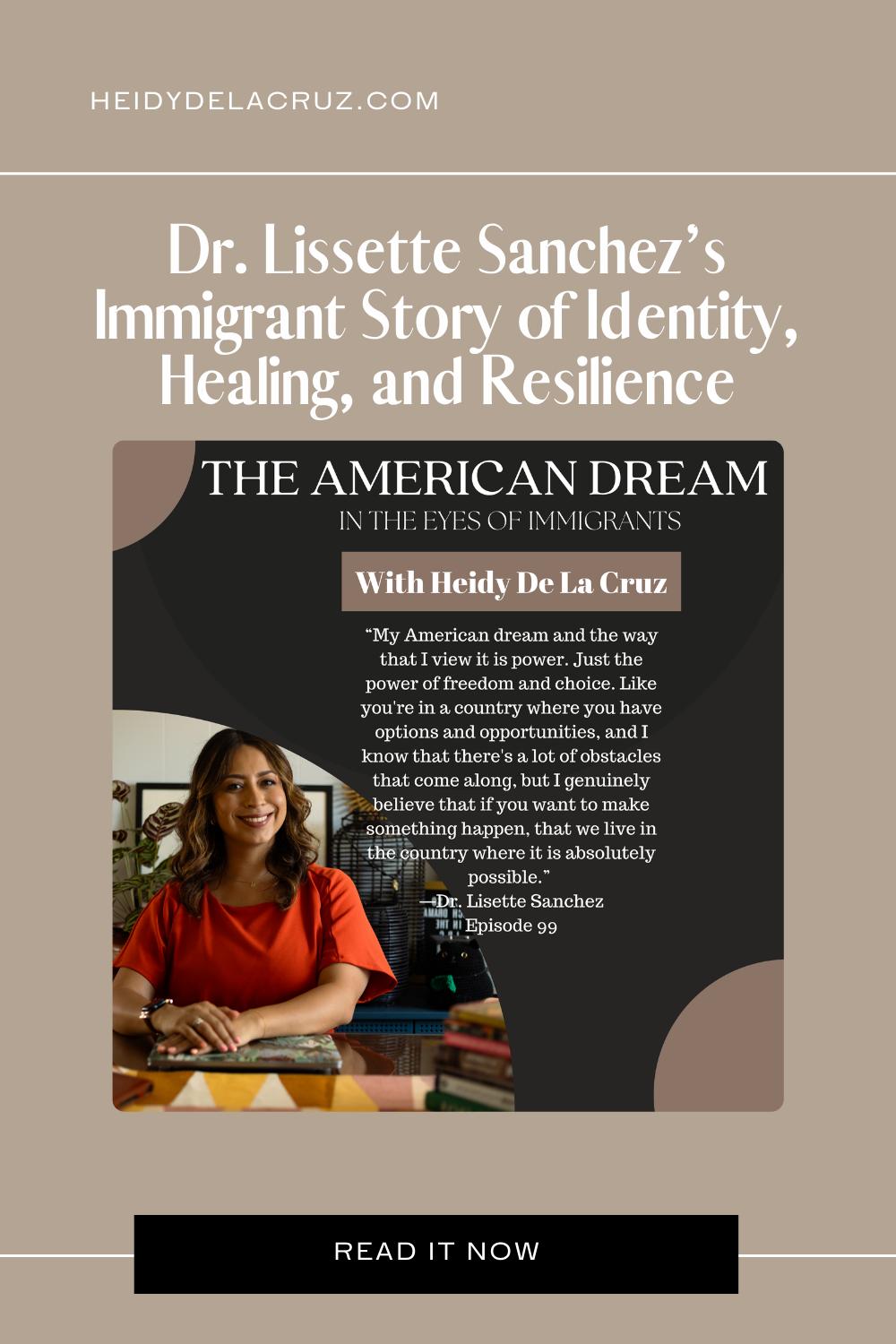
“The American Dream,” she says, “is knowing you have the power to create something of your own.”
With Love, Heidy
Join the Substack community for The American Dream in the Eyes of Immigrants Podcast and receive the episodes in your inbox. You can also leave comments, interact with other listeners, and listen to ad-free episodes.
Other Posts You May Enjoy: